


ISS Previous Year Paper 2019 GS Solution Question 3(e) Credit-Deposit Ratio and Low-Income States in India
ISS Previous Year Paper 2019 GS Solution Question 3(e) Credit-Deposit Ratio and Low-Income States in India. Detailed answer discussing the causes and implications of low Credit-Deposit Ratio in economically weaker states.
ISS Previous Year Paper 2019 GS Solution Question
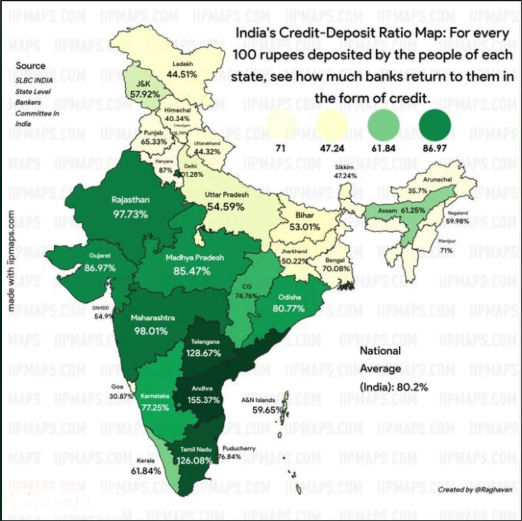
Q.3(e) What is the Credit-Deposit Ratio? Why is it generally low in low-income states of India?
Answer :
The Credit-Deposit Ratio (CD Ratio) refers to the ratio of total bank credit (loans and advances) to total bank deposits. It indicates the extent to which deposits collected by banks are being used for lending purposes within a region.
A high CD Ratio generally reflects greater economic activity and better utilization of financial resources, whereas a low CD Ratio indicates limited credit expansion and weaker economic development.
In many low-income states such as Bihar, Jharkhand, Odisha, and some northeastern states, the CD Ratio tends to remain low due to several factors.
One major reason is the limited industrial and commercial base. Lower levels of industrialization reduce the demand for productive credit and investment. The absence of large-scale economic activities limits borrowing opportunities.
Another factor is inadequate infrastructure, including poor transportation, electricity, and communication facilities. These constraints discourage investment and reduce the viability of business enterprises.
Low levels of financial literacy, limited entrepreneurship, and a higher proportion of informal economic activities also contribute to weak credit absorption. Banks may perceive lending in such regions as risky because of lower repayment capacity and inadequate collateral availability.
As a result, a substantial portion of deposits mobilized in these states is often deployed elsewhere where investment opportunities are more attractive.
Improving infrastructure, promoting entrepreneurship, enhancing financial inclusion, and encouraging industrial development can help raise the Credit-Deposit Ratio in low-income states.
Conclusion
The Credit-Deposit Ratio is an important measure of financial development and economic activity. Addressing structural constraints and expanding investment opportunities are essential for improving credit flow and accelerating development in low-income states.

Comments